This essay is part of the series in which I talk about my learnings and insights building a habit coaching app (Nintee) in 2024. It didn’t ultimately work out because an app has marginal influence in a human’s life (v/s that of friends, family, culture and immediate environment). Most apps that work in the category operate like gyms (charge upfront when the motivation is high, and be okay with high churn). I had raised VC funding for it and later it became clear to me that this wouldn’t be a VC scale business, so I shut it down and returned the remaining funding. Hope the insights learned along the way would turn out to be valuable to others.
This series comprises of the following essays:
- Science of habit building: how habits are formed and broken
- Making a product that Marl loves: why well-intentioned apps ultimately become attention-seeking and gamified
- The two views of rationality: what is true v/s what is useful
- How does behavior change happen (this one): frameworks and mental models for human behavior change
- How to coach someone: 21 points to keep in mind while coaching someone
Subscribe to the blog if you want to be notified of future essays.
Get my new essays in your email
Behavior change is very hard. People know what is good for them, they’re motivated to do those things, and yet aren’t able to get things done. Why?
Nudging for behavior change
For any change to happen in humans, two forces help:
- Gas (motivation)
- The more motivated I’m for something, the more likely I’ll do something
- Brake (friction)
- The smaller the delta b/w my current life and what new is expected from me (i.e. the less the friction), the more likely I’ll do something
For a behavior to get built into a habit, we also need:
- Right context and repetitions
- Context can be a trigger or a location or visuals of it
- Repetitions are how behaviors transform into behaviors
But notice that motivation doesn’t remain the same every day
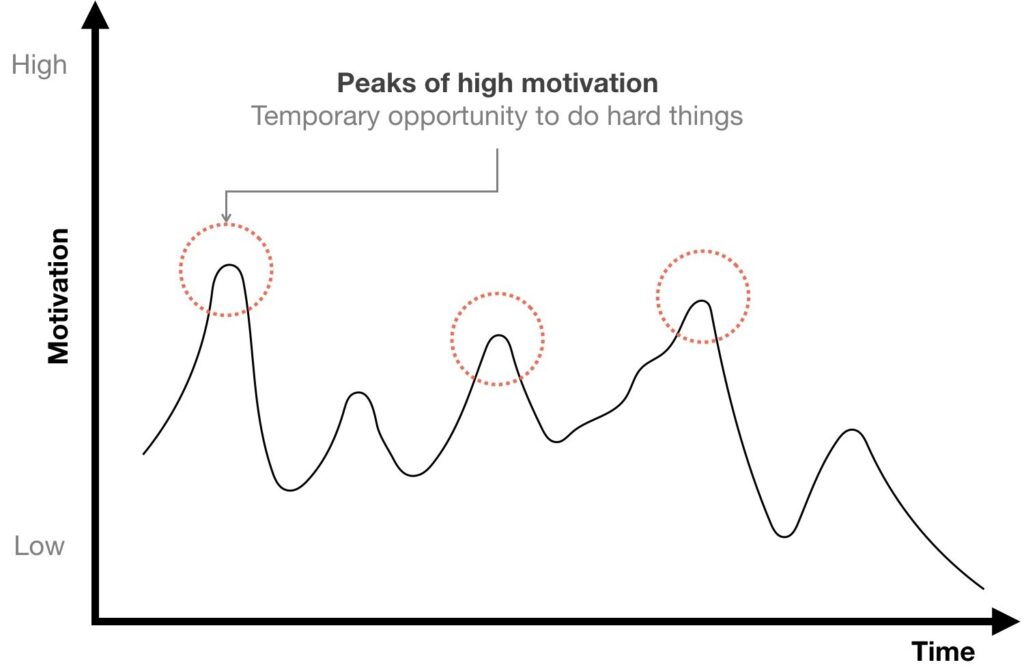
via UI-patterns.com
We can utilize these levers we have for changing behavior and then pushing that behavior change into a habit:
- Increasing motivation to start
- Reducing friction
- Triggering reminders in the right context
- Motivating for repeat
Let’s look at each of these levers separately.
Increasing motivation to start
There’s not a lot we can do about this lever. Nintee’s approach at that time for motivating people was through challenges (such as committing to 30 day push up challenge). They (sort of) work because there’s a clear end goal that’s slightly outside of comfort zone. The game-like clear goal then becomes motivating.
However, the analogy with a game goes only so far – games require relatively less effort but give frequent feedback. Challenges like we had were by definition hard to do naturally (for a person).
Multiple levels of challenges
Our hypothesis was that multiple levels of challenges would help, just like good games have multiple layers. Example:
- Challenge -> daily feedback
- Once people have done enough checkins, give them an option to challenge themselves further by:
- Increasing difficulty
- Increasing consistency commitment
- Once people have input enough information, challenge them to:
- Beat their personal best
- Try fun variations of the challenge
Reducing friction
People come across so many tweets and videos that tell them to lift weights, eat no sugar, etc. And yet, they don’t do that because of the big gap from existing life/habits and new ones is big.
For example, imagine kinds of things a person will have to change in order to not have sugar:
- Not get tempted when friends come with a cake
- Stop sugar that they often have with tea
- Not go for post-dinner walk because often that was accompanied by ice-cream
- Not celebrate occasions because sweets always come with that
Practically speaking, giving up on sugar is impossible. So, for all intents and purposes, we end up suggesting to someone in our app that they should “give up sugar”, we should treat it as equivalent to reading a tweet (and hence assume such behavior change is not going to happen.)
What we should do instead is ask them to make a tiny change, which is easy to perform, and then give them hope that we will build upon this tiny thing over time.
In our MVP (which as AI driven habit coach on Discord), we missed the mark on two fronts:
- We suggested significant changes (which user is never going to do)
- Even if in some cases we suggested tiny actionables, we never educated them on how tiny progress is going to compound to big changes
- We just assumed that people will understand the nature of compounding on tiny wins by themselves
- For example, telling people to do 10 minute meditation without educating them how this can help them build a habit of meditation is a lost cause (+ showing proof how other people have gone about this)
Hence, for suggested new behaviors, we had decided:
- For majority of cases:
- Assume we can’t change people, only make it easy for them to do what they are already doing
- For minority of cases:
- Where we suggest something new, suggest something extremely tiny AND show them the big picture how this tiny thing can grow over time + how such growth can help achieve their goals
Triggering reminders in the right context
The more the intentional new activity that we want the user to take, the more we need to remind them. These reminders have to be varied (so people don’t get bored) and contextual to what new activity we want them to be reminded of.
For example, if the challenge is to carry a book at work. Then we should know the time the user leaves for work, and trigger a reminder 1 hour before (on the likes of: “Which book are you planning to carry today?”). And then we should remind them to check in 1 hour later, if they haven’t.
Important nuance: trigger to help someone NOT do something (like not have coffee) is very different from trigger to do something (like start doing push-ups)
Motivation for repetitions
The more they repeat a behavior, the more likely such behaviors end up becoming habits.
We motivate people to repeat via the following ways:
- Streaks
- People are mad about streaks
- Relevant positive reinforcement on each repetition
- AI based and people/community based
- Reinforcement of how repetition will help achieve the goal
- Each repetition, how them the way of progress
Wishlist of Features in Nintee
Based on all of the above, we could imagine Nintee to help with a continuum of behaviors.
Persona JTBD
Pitch (how Nintee helps)
Consistent
Behaviors that the user is already more or less consistently doing
Don’t fall out of consistency (streaks)
Master / go deeper into the activity (increasing difficulty)
Learn from other people doing similar activities (feed)
Deepen your understanding of the domain (learning via bot or separate tab)
Maintain a historical log of your data and reflections (checkins)
Want consistency
Behaviors that the user is struggling or has struggled to do consistently
Challenge yourself to beat a goal (the concept of challenges) and get inspired by people doing similar challenges
Remain motivated by learning how a behavior will help you progress towards your life’s goals (learning chatbot)
Get positive reinforcement
Reduce friction in the behavior you’re trying to inculcate, atomic habits style (personalized challenge suggestion that aims at consistency first, intensity later)
Increase chances of not giving up by learning how to avoid your specific barriers
Get motivating reminders at the right time to help you with extra push (reminders)
Build consistency by counting streaks of repetition
Reduce difficulty level when becoming inconsistent
Untried
These are behaviors that are entirely new (user has never tried before) – the hardest one to inculcate for anyone (let alone an app)
Learn how the new behavior can help with life’s goals (learning tab and/or chatbot) – ideally, we need citations/references or trust, as this info is easily available with a tweet, but often not enough to motivate people to try
Get inspired by seeing people talking / sharing about a behavior (community/feed)
See the simplest behavior you can perform and how it can compound to the new one (the plan, habit stacking – not doing)
Eventually, we needed to target all 3 JTBD (consistent, want consistency, untried) but to start off with, we focused on “want consistency” JTBD as that’s where the most customer pain lies (others are sort of vitamins/good to have).
Join 200k followers
Follow @paraschopra
Get my new essays in your email