“Anything perceived has a cause.
All conclusions have premises.
All effects have causes_._
All actions have motives.”
— Arthur Schopenhauer
***
The Basics
One of the first principles we learn as babies is that of cause and effect. Infants learn that pushing an object will cause it to move, crying will cause people to give them attention, and bumping into something will cause pain. As we get older, this understanding becomes more complex. Many people love to talk about the causes of significant events in their lives (if I hadn’t missed the bus that day I would never have met my partner! or if I hadn’t taken that class in college I would never have discovered my passion and got my job!) Likewise, when something bad happens we have a tendency to look for somewhere to pin the blame.
The mental model of proximate vs root causes is a more advanced version of this reasoning, which involves looking beyond what appears to be the cause and finding the real cause. As a higher form of understanding, it is useful for creative and innovative thinking. It can also help us to solve problems, rather than relying on band-aid solutions.
Much of our understanding of cause and effect comes from Isaac Newton. His work examined how forces lead to motion and other effects. Newton’s laws explain how a body remains stationary unless a force acts upon it. From this, we can take a cause to be whatever causes something to happen.
For example, someone might ask: Why did I lose my job?
- Proximate cause: the company was experiencing financial difficulties and could not continue to pay all its employees.
- Root cause: I was not of particular value to the company and they could survive easily without me.
This can then be explored further: Why was I not of value to the company?
- Ultimate cause: I allowed my learning to stagnate and did not seek constant improvement. I continued doing the same as I had been for years which did not help the company progress.
- Even further: Newer employees were of more value because they had more up-to-date knowledge and could help the company progress.
This can then help us to find solutions: How can I prevent this from happening again?
- Answer: In future jobs, I can continually aim to learn more, keep to date with industry advancements, read new books on the topic and bring creative insights to my work. I will know this is working if I find myself receiving increasing amounts of responsibility and being promoted to higher roles.
This example illustrates the usefulness of this line of thinking. If our hypothetical person went with the proximate cause, they would walk away feeling nothing but annoyance at the company which fired them. By establishing the root causes, they can mitigate the risk of the same thing happening in the future.
There are a number of relevant factors which we must take into account when figuring out root causes. These are known as predisposing factors and can be used to prevent a future repeat of an unwanted occurrence.
Predisposing factors tend to include:
- The location of the effect
- The exact nature of the effect
- The severity of the effect
- The time at which the effect occurs
- The level of vulnerability to the effect
- The cause of the effect
- The factors which prevented it from being more severe.
Looking at proximate vs root causes is a form of abductive reasoning- a process used to unearth simple, probable explanations. We can use it in conjunction with philosophical razors (such as Occam’s and Hanlon’s) to make smart decisions and choices.
In Root Cause Analysis, Paul Wilson defines root causes as:
Root cause is that most basic reason for an undesirable condition or problem which, if eliminated or corrected, would have prevented it from existing or occurring.
In Leviathan, Chapter XI (1651) Thomas Hobbes wrote:
Ignorance of remote causes disposeth men to attribute all events to the causes immediate and instrumental: for these are all the causes they perceive…Anxiety for the future time disposeth men to inquire into the causes of things: because the knowledge of them maketh men the better able to order the present to their best advantage. Curiosity, or love of the knowledge of causes, draws a man from consideration of the effect to seek the cause; and again, the cause of that cause; till of necessity he must come to this thought at last that there is some cause whereof there is no former cause.
In Maxims of the Law, Francis Bacon wrote:
It were infinite for the law to consider the causes of causes, and their impulsions one of another; therefore it contented itself with the immediate cause, and judgeth of acts by that, without looking to any further degree.
A rather tongue in cheek perspective comes from the ever satirical George Orwell:
Man is the only real enemy we have. Remove Man from the scene, and the root cause of hunger and overwork is abolished forever.”
The issue with root cause analysis is that it can lead to oversimplification and it is rare for there to be one single root cause. It can also lead us to go too far (as George Orwell illustrates.) Over emphasizing root causes is common among depressed people who end up seeing their existence as the cause of all their problems. As a consequence, suicide can seem like a solution (although it is the exact opposite.) The same can occur after a relationship ends, as people imagine their personality and nature to be the cause. To use this mental model in an effective manner, we must avoid letting it lead to self blame or negative thought spirals. When using it to examine our lives, it is best to only do so with a qualified therapist, rather than while ruminating in bed late at night. Finding root causes should be done with the future in mind, not for dwelling on past issues. Expert root cause analysts use it to prevent further problems and create innovative solutions. We can do the same in our own lives and work.
“Shallow men believe in luck or in circumstance. Strong men believe in cause and effect.”
— Ralph Waldo Emerson
Establishing Root Causes
Establishing root causes is rarely an easy task. However, there a number of techniques we can use to simplify the deduction process. These are similar to the methods used to find first principles:
Socratic questioning
Socratic questioning is a technique which can be used to establish root causes through strict analysis. This a disciplined questioning process used to uncover truths, reveal underlying assumptions and separate knowledge from ignorance. The key distinction between Socratic questioning and normal discussions is that the former seeks to draw out root causes in a systematic manner. Socratic questioning generally follows this process:
- Clarifying thinking and explaining origins of ideas. (What happened? What do I think caused it?)
- Challenging assumptions. (How do I know this is the cause? What could have caused that cause)
- Looking for evidence. (How do I know that was the cause? What can I do to prove or disprove my ideas?)
- Considering alternative perspectives. (What might others think? What are all the potential causes? )
- Examining consequences and implications. (What are the consequences of the causes I have established? How can they help me solve problems?)
- Questioning the original questions. (What can I do differently now that I know the root cause? How will this help me?)
The 5 Whys
This technique is simpler and less structured than Socratic questioning. Parents of young children will no doubt be familiar with this process, which necessitates asking ‘why?’ five times to a given statement. The purpose is to understand cause and effect relationships, leading to the root causes. Five is generally the necessary number of repetitions required. Each question is based on the previous answer, not the initial statement.
Returning to the example of our hypothetical laid off employee (mentioned in the introduction), we can see how this technique works.
- Effect: I lost my job.
- Why? Because I was not valuable enough to the company and they could let me go without it causing any problems.
- Why? Because a newer employee in my department was getting far more done and having more creative ideas than me.
- Why? Because I had allowed my learning to stagnate and stopped keeping up with industry developments. I continued doing what I have for years because I thought it was effective.
- Why? Because I only received encouraging feedback from people higher up in the company, and even when I knew my work was substandard, they avoided mentioning it.
- Why? Because whenever I received negative feedback in the past, I got angry and defensive. After a few occurrences of this, I was left to keep doing work which was not of much use. Then, when the company began to experience financial difficulties, firing me was the practical choice.
- Solution: In future jobs, I must learn to be responsive to feedback, aim to keep learning and make myself valuable. I can also request regular updates on my performance. To avoid becoming angry when I receive negative feedback, I can try meditating during breaks to stay calmer at work.
As this example illustrates, the 5 whys technique is useful for drawing out root causes and finding solutions.
Cause and Effect Mapping

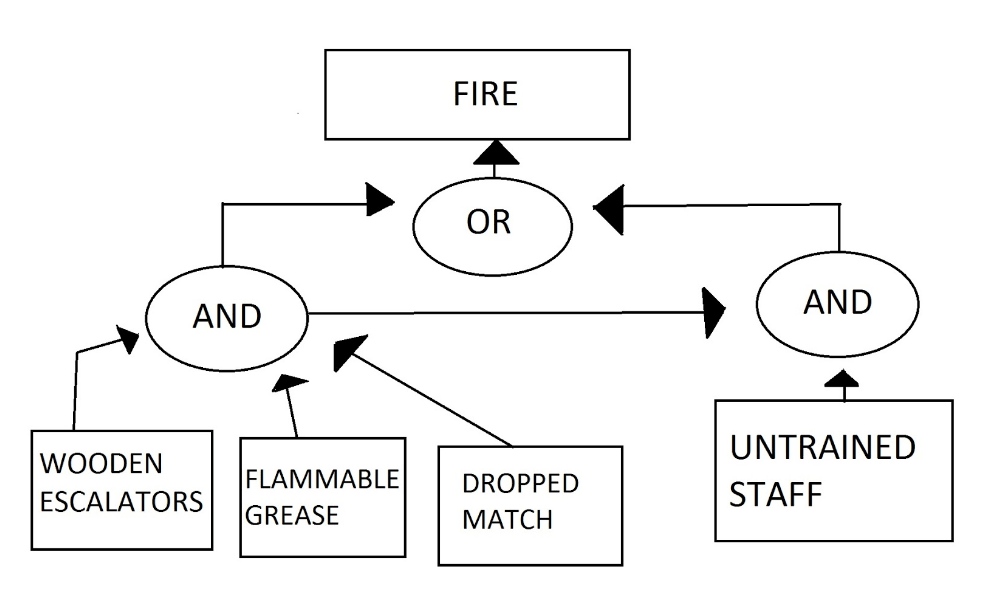
This technique is often used to establish causes of accidents, disasters, and other mishaps. Let’s take a look at how cause and effect mapping can be used to identify the root cause of a disaster which occurred in 1987: The King’s Cross fire. This was a shocking event, where 31 people died and 100 were injured in a tube station fire. It was the first fatal fire to have occurred on the London Underground and led to tremendous changes in rules and regulations. This diagram shows the main factors which led to the fire, and how they all combined to lead to the tragic event. Factors included: flammable grease on the floors which allowed flames to spread, flammable out of date wooden escalators, complacent fire staff who failed to control the initial flames, untrained staff with no knowledge of how to evacuate people, blocked exits (believed to be due to cleaning staff negligence) and a dropped match (assumed to have been discarded by someone lighting a cigarette.)
Once investigators had established these factors which led to the fire, they could begin looking for solutions to prevent another fatal fire. Of course, solving the wrong problem would have been ineffective. Let’s take a look at each of the causes and figure out the root problem:
- Cause: A dropped match. Smoking on Underground trains had been banned 3 years prior, but many people still lit cigarettes on the escalators as they left. Investigators were certain that the fire was caused by a match, and was not arson. Research found that many other fires had began in the past, yet had not spread. This alone did not explain the severity of this particular fire. Better measures have since been put into place to prevent smoking in stations (although Londoners can vouch for the fact that it still occasionally happens late at night or in secluded stations.)
- Cause: flammable grease on escalators. Research found that this was indeed highly flammable. Solving this would have been almost impossible- the sheer size of stations and the numbers of people passing through them made thorough cleaning difficult. Solving this alone would not have been sufficient.
- Cause: wooden escalators. Soon after the fire, stations began replacing these with metal (although it took until 2014 for the entire Underground network to replace every single one.
- Cause: untrained staff. This was established to be the root cause. Even if the other factors were resolved, the lack of staff training or access to fire fighting equipment still left a high risk of another fatal incident. Investigations found that staff were only instructed to call the Fire Brigade once a fire was out of control, most had no training and little ability to communicate with each other. Once this root cause was found, it could be dealt with. Staff were given improved emergency training and better radio tools for communicating. Heat detectors and sprinklers were fitted in stations.
From this example, we can see how useful finding root causes is. The lack of staff training was the root cause, while the other factors were proximate causes which contributed.
From this information, we can create this diagram to illustrate the relationship between causes.
“All our knowledge has its origins in our perceptions … In nature, there is no effect without a cause … Experience never errs; it is only your judgments that err by promising themselves effects such as are not caused by your experiments.”
- Leonardo da Vinci
How We Can Use This Mental Model as Part of our Latticework

- Hanlon’s Razor — This mental model states: never attribute to malice that which can be attributed to incompetence. It is relevant when looking for root causes. Take the aforementioned example of the Kings Cross fire. It could be assumed that staff failed to control the fire due to malice. However, we can be 99% certain that their failure to act was due to incompetence (the result of poor training and miscommunication.) When analysing root causes, we must be sure not to attribute blame where it does not exist.
- Occam’s Razor — This model states: the simplest solution is usually correct. In the case of the fire, there are infinite possible causes which could be investigated. It could be said that the fire was started on purpose, the builders of the station made it flammable on purpose so they would be required to rebuild it that the whole thing is a conspiracy theory and people actually died in an alternate manner. However, the simplest solution is that the fire was caused by a discarded match. When looking for root causes, it is wise to first consider the simplest potential causes, rather than looking at everything which could have contributed.
- Arguing from first principles — This mental model involves establishing the first principles of any given area of knowledge- information which cannot be deduced from anything else. Understanding the first principles of how fire spreads (such as the fire triangle) could have helped to prevent the event.
- Black swans — This model, developed by Nassim Taleb is: “an event with the following three attributes. First, it is an outlier, as it lies outside the realm of regular expectations because nothing in the past can convincingly point to its possibility. Second, it carries an extreme impact…. Third, in spite of its outlier status, human nature makes us concoct explanations for its occurrence after the fact, making it explainable and predictable.” The King’s Cross fire was a black swan- surprising, impactful and much analyzed afterwards. Understanding that black swans do occur can help us to plan for serious events before they happen.
- Availability bias — This model states: we misjudge the frequency of events which have happened recently and information which is vivid. Imagine a survivor of the Kings Cross fire who had also been on a derailed train a few months earlier. The intensity of the two memories would be likely to lead them to see travelling on the Underground as dangerous. However, this is not the case – only one in 300 million journeys experience issues (much safer than driving.) When devising root causes, we must be sure to consider all information, not just that which comes to mind with ease.
- Narrative fallacy — This model states: we tend to turn the past into a narrative, imagining events as fitting together in a manner which is usually false.
- Hindsight bias — This model states: we see events as predictable when looking back on them.
- Confirmation bias — This model states: we tend to look for information which confirms pre-existing beliefs and ideas.